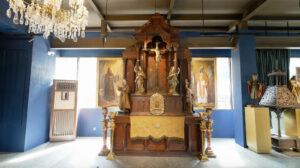
FOR the Philippine Ambassador to Spain, Philippe J. Lhuillier, his decades of diplomatic service are best represented by the religious artifacts, European antiques, and culturally significant memorabilia that he has collected over the years. His legacy as a diplomat extends beyond the work itself, through religious and cultural heritage.
In Museo P. Lhuillier, a new museum housing Mr. Lhuillier’s extensive personal collection, visitors catch a glimpse of his storied legacy. It includes sacred objects, significant artworks, historical artifacts, and items detailing the narrative of the Cebuana Lhuillier Foundation.
The museum, located in Antipolo City, is set to open in 2026. A media preview was held on Dec. 5.
“Many of these pieces have been carefully kept for years. It has long been my hope to make these pieces accessible to the Filipino public,” Mr. Lhuillier said at the event. “My hope is that Museo P. Lhuillier becomes a place of reflection and discovery, where visitors can connect with stories of faith, heritage, and global tradition.”
A new cultural and spiritual landmark in Antipolo City, the museum’s four stories are divided into three sections — religious art, furniture, and ivory and silver — in total adding up to over 500 pieces on display.
“What we display here are not simply collections, but reflections of chapters that formed my father’s outlook, values, and his way of living with kindness and purpose,” said Camille Lhuillier-Albani, general manager of Casa de Memoria, the Lhuillier family’s auction house.
She explained that this is why there is a gallery tracing the ambassador’s personal and professional journey through items that he had collected, mirroring his “diplomatic career, personal history, and devotion.”
A lot of the works date back to the 17th century, many of which were sourced from flea markets and churches in Europe that were on the verge of closure.
The museum also places emphasis on religious sculptures of the Madonna and Child and Sta. Rosa de Lima, which are the centers of Mr. Lhuillier’s religious devotion. They can be found in the Kapilya de Santa Rosa de Lima, a little sanctuary for devotion and contemplation.
“Growing up, we often saw how much these pieces meant to him. Seeing them now shared with the public feels deeply special. This museum reflects not only his love for art and history, but his desire to give Filipinos a place for quiet reflection and connection,” said Ms. Lhuillier-Albani.
The furniture on view comes in Victorian, Baroque, and Rococo styles. Meanwhile, the ivory and silver section houses many ornate items including cabinets traditionally used to hold religious items and jewelry.
Museo P. Lhuillier’s APJL Hall gives insight into key milestones in Mr. Lhuillier’s 17-year journey in foreign service. The museum’s upper floors also detail his and his family’s work through the Cebuana Lhuillier network of pawnshops, which has an active foundation regularly leading philanthropic initiatives.
“Throughout his diplomatic career in Italy, Albania, San Marino, Portugal, and now Spain, my dad has championed the welfare of overseas Filipinos, strengthened bilateral relations, and elevated our culture abroad,” said Jean Henri Lhuillier, president and chief executive officer of Cebuana Lhuillier, at the preview.
He added that this dedication to service has always served as an inspiration. “Seeing his impact reflected in this museum is deeply meaningful,” the younger Mr. Lhuillier said.
The museum will host a rotating pop-up gallery, featuring seasonal exhibitions, collaborations, and programs meant to spark cultural engagement.
Overall, the curation aims to “inspire meaningful connections and encourage visitors to explore the richness of shared heritage,” according to Ms. Lhuillier-Albani.
She pointed out that the country’s Filipino-Hispanic architecture, represented by wooden lattice patterns, woven rattan accents, and bahay na bato elements, can be found throughout the museum.
The younger Mr. Lhuillier said that he’s sure many Filipinos will appreciate what the museum has to offer, when it officially opens in early 2026. “My dad has been collecting many of these pieces for years, and finally, we have a space to share them with the public. This facility ensures that everyone can enjoy and appreciate Filipino culture,” he said.
Guests can plan their visit through www.museo-plhuillier.com or the Museo P. Lhuillier Facebook page. Entrance costs P250 for adults and P100 for young people ages 19 to 24. — Brontë H. Lacsamana