Vehicle sales in the Philippines post modest growth in 2025 as the industry heads into the final months of the year with tempered momentum but steady demand.
Even with slower gains toward the fourth quarter, the Chamber of Automotive Manufacturers of the Philippines, Inc. (CAMPI) and the Truck Manufacturers Association (TMA) project total vehicle sales to reach about 486,000 units by year’s end. The updated outlook falls below the earlier 500,000 unit goal but still represents growth of about 4% compared with 2024.
CAMPI President Rommel R. Gutierrez points to improved availability of vehicles and stronger buyer interest in newer technologies as factors supporting sales as 2025 draws to a close.
Automakers also benefit from a consumer base that remains active despite higher borrowing costs and rising household expenses. Buyers show caution, but showrooms still see steady traffic.
Meanwhile, electric and hybrid models account for about 9% of all new vehicles sold in October, a sharp rise compared with earlier periods. Hybrid vehicles post the strongest gains within the segment, recording solid month-to-month increases.
As fuel prices remain unstable and urban driving grows more demanding, automakers respond with electric and hybrid models that offer longer range, lower running costs, and features aimed at daily use.
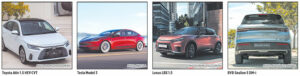
Toyota ATIV
Toyota Motor Philippines targets a broader audience with the all-new ATIV, a subcompact sedan designed for professionals and first-time car owners. The biggest headline sits with the introduction of a hybrid electric variant, positioned as Toyota’s most accessible electrified passenger car in the local lineup.
The ATIV HEV uses a 1.5-liter four-cylinder hybrid engine paired with Continuously Variable Transmission, delivering a combined system output of 111 horsepower. Toyota also offers gasoline variants with 1.3-liter and 1.5-liter engines, giving buyers a range of price points and performance levels.
On the road, the ATIV focuses on ease of use. Its dimensions strike a balance between interior space and city maneuverability. The fastback-style silhouette, LED headlamps and available sequential rear turn signals give it a sharper profile than earlier subcompact sedans.
A 7-inch digital multi-information display comes standard, with the hybrid variant offering up to a 10.1-inch display audio system with wireless smartphone connectivity. Seating accommodates five, with a layout aimed at daily commuting and family use.
Toyota Safety Sense appears on the ATIV, bringing features such as pre-collision detection, automatic high beam, lane tracing assist and lane departure alert. The hybrid variant adds adaptive cruise control. All versions include air bags, anti-lock brakes with brake assist, vehicle stability control, blind spot monitoring and International Standards Organisation Fix (ISOFIX) child seat anchors.
Toyota backs the ATIV with an expanded ownership package. Vehicles sold from January 2025 onward qualify for a five-year warranty program, subject to meeting periodic maintenance requirements at authorized dealers. The program extends coverage beyond the previous three-year term.
Tesla Model 3
Tesla opens 2025 with an updated Model 3 lineup that adds features without raising prices. The rear-wheel-drive version starts at P2.109 million; the Long Range all-wheel-drive model is priced at P2.489 million; and the Performance all-wheel-drive variant carries a P3.099-million price tag.
The latest Model 3 includes a front-facing camera designed to assist with parking and low-speed maneuvers. Tesla says this camera also supports the brand’s driver-assist system, which now relies on eight cameras. Exterior updates are subtle, including matte black Tesla badges on the front and rear.
Inside, Tesla restores a traditional turn signal stalk, replacing the steering wheel buttons some drivers found awkward. Such adjustment is expected to make basic driving inputs more familiar, particularly for those new to electric vehicles.
Range figures have improved for the updated models. The Long Range all-wheel-drive version can travel up to 660 kilometers on a single charge, the Performance model reaches 571 kilometers, and the rear-wheel-drive variant remains at 520 kilometers. These distances place the Model 3 among the longest-range electric sedans available in the Philippines.
Currently, Tesla Philippines operates 10 stations in Metro Manila and one hub in Antipolo, Rizal.
Lexus LBX
Lexus pushes into new territory with the LBX, its most compact hybrid yet. The model pairs a 1.5-liter inline three-cylinder gasoline engine with a high-output electric motor.
The LBX produces 134 horsepower and reaches 100 kilometer per hour in 9.2 seconds, with a listed top speed of 170 kilometer per hour. Front-wheel drive and a low center of gravity shape its road manners, while MacPherson struts up front and a torsion beam at the rear handle daily driving demands.
In terms of design, a low-slung hood, aligned roofline and sculpted bumpers give the vehicle a planted stance despite its compact size. The updated spindle grille integrates sensors and cooling functions without overwhelming the front profile. LED lighting appears throughout, from headlamps to rear combination lamps, reinforcing its modern look.
Inside, Lexus focuses on comfort and usability. Smooth leather and Ultrasuede seats, power adjustment for the driver and dual-zone automatic climate control set the tone. A 9.8-inch display anchors the dashboard, paired with a 7-inch digital instrument cluster. Apple CarPlay and Android Auto come standard, along with multiple USB-C ports and a wireless charging pad.
Meanwhile, Lexus Safety Sense includes a pre-collision system using radar and a monocular camera, lane tracing assist, adaptive high beam and all-speed dynamic radar cruise control. Blind spot monitoring, rear cross-traffic alert and a full complement of air bags round out the list.
BYD Sealion 5 DM-i
BYD adds another model to its Philippine lineup with the Sealion 5 DM-i. Its exterior features angular headlights, a wide front grille with horizontal slats, silver trim on the lower fascia, a light bar at the rear, plastic cladding, a small roof spoiler, and 18-inch two-tone alloy wheels.
The cabin follows BYD’s typical layout, with a large rotating touchscreen at the center of the dashboard, supported by physical buttons and knobs. Beige and brown trim combine with leather, fabric, and hard plastics. Wired Apple CarPlay and Android Auto come standard, along with speed-sensing door locks and a tire-pressure monitoring system.
The Sealion 5 is powered by a Super DM-i range-extended hybrid system. A 1.5-liter gasoline generator feeds a front-mounted electric motor producing 197 horsepower and 300 Newton-meters of torque. Under New European Driving Cycle (NEDC) testing, the vehicle can travel up to 71 kilometers on electric power alone. With a full tank and charged battery, BYD lists a combined range of 1,001 kilometers.
Performance figures include a 0-100 kilometer-per-hour time of 8.3 seconds. The vehicle uses a front-wheel-drive layout, a Blade Battery with 12.96-kilowatt-hour capacity, a MacPherson strut front suspension, a multi-link rear suspension, and disc brakes on all wheels.
Unlike some competitors, safety equipment focuses on essentials such as six air bags and rear parking sensors.
BYD markets the model to buyers who want hybrid efficiency and long-distance capability without moving into higher price brackets. — Mhicole A. Moral