
By Beatriz Marie D. Cruz, Reporter
THE PHILIPPINES climbed seven spots in the Government AI Readiness Index by Oxford Insights but scored low in securing artificial intelligence (AI) infrastructure and resilience.
The country ranked 49th out of 195 countries with a score of 57.76 out of a possible 100 in the index, outperforming the regional average of 49.11.
The Philippines ranked ninth among its peers in the Asia-Pacific region, according to the report
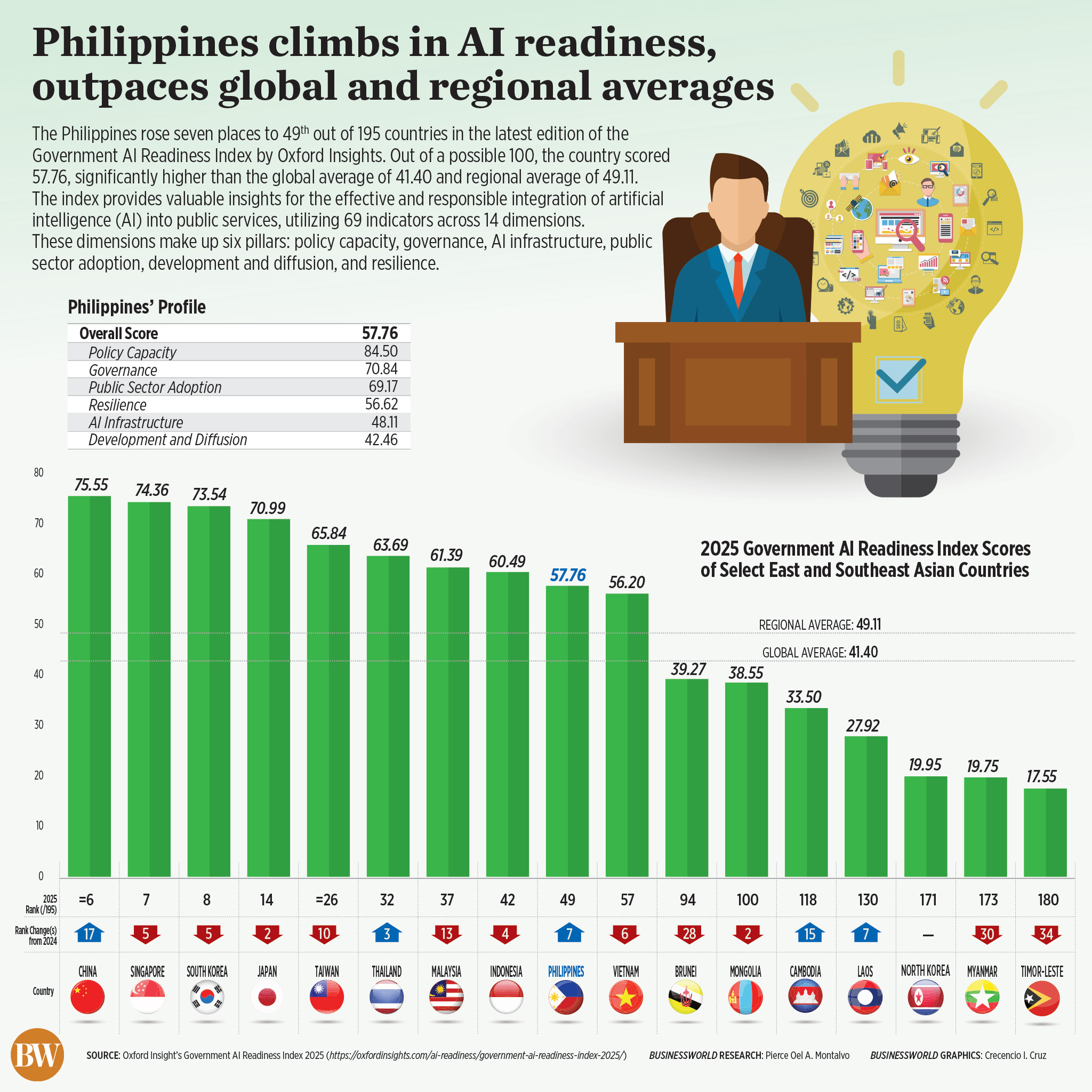
China ranked sixth overall with a score of 75.55, followed by Singapore (7th), South Korea (8th), Japan (14th), Taiwan (26th), Thailand (32nd), Malaysia (37th), and Indonesia (42nd).
The Philippines was ahead of Vietnam (57th), Brunei (94th), Mongolia (100th), Cambodia (118th), Laos (130th), North Korea (171st), Myanmar (173rd), and Timor-Leste (180th).
The country’s score was also higher than the global average of 41.40, the report showed.
The index measures a country’s effective and responsible integration of AI into public services based on 69 indicators across 14 dimensions.
These dimensions form six pillars: policy capacity, governance, AI infrastructure, public sector adoption, development and diffusion, and resilience.
According to the report, the Philippines scored 84.50 on policy capacity, 70.84 on governance, 69.17 on public sector adoption, and 56.62 on resilience.
Meanwhile, the country received low scores in AI infrastructure (48.11) and development and diffusion (42.46).
“What the current results suggest is we are strong in policy capacity and governance, but weak everywhere else. Our biggest weakness is AI infrastructure and public sector adoption,” Philippine AI Business Association Director for AI Ethics & Data Governance Dominic Vincent D. Ligot said in a Viber message.
The Department of Science and Technology has said it plans to invest P2.6 billion for AI projects through 2028.
The government has also launched AI roadmaps and filed proposed laws in Congress that aim to position the Philippines as a regional AI powerhouse.
However, Filipinos have yet to feel the benefits of the government’s AI adoption push as they face connectivity and digital literacy challenges, said Reynaldo C. Lugtu, Jr., chief executive officer of digital transformation consultant Hungry Workhorse Consultancy, Inc.
“In far-flung provinces and among micro, small, and medium enterprises, AI remains abstract — something that exists in press releases and pilot projects more than in daily life,” he said in an e-mail.
Oxford Insights also cited the Asia-Pacific region’s vibrant AI ecosystem, which benefits from a tech-savvy population, high use of mobile phones, and strong digital penetration.
The Philippines, which will assume chairmanship of the Association of Southeast Asian Nations (ASEAN) regional bloc next year, “could be an important voice in defining an ‘ASEAN way’ for the AI era,” the think tank said.
Mr. Ligot said the Philippines is at a turning point. “There’s momentum, but we need to turn that into broad-based impact,” he added.
The government must boost investments on modern data services to boost connectivity in rural communities, Mr. Lugtu said.
He also cited the need to increase public education and skills training for Filipinos to understand the benefits of AI across sectors, including healthcare, education, agriculture, or disaster response.
“We have to design AI solutions that speak local languages and reflect Filipino contexts because that’s when the technology feels useful, not foreign,” Mr. Lugtu said.
State-run institutions should also collaborate with startups, universities, and civil society to build on-the-ground AI solutions, he added.
Mr. Ligot also noted that the government should boost AI-related infrastructure, such as data centers, to support widespread AI use. It should also fast-track an AI code of conduct to ensure its ethical use while supporting innovation, he added.
Leonardo A. Lanzona, Jr., an economics professor at the Ateneo de Manila University, said the government should work with labor organizations to ensure that AI doesn’t result in job losses.
“AI dividends can be used to make labor more productive while substituting the need to use capital or imported inputs,” he said in a Facebook Messenger chat.
The government must also refine Science, Technology, Engineering, and Mathematics courses to equip students with core skills related to AI, Rizal Commercial Banking Corp. Chief Economist Michael L. Ricafort said.