By Erika Mae P. Sinaking
HOUSE MINORITY lawmakers on Thursday asked the Supreme Court (SC) to nullify the P150.9-billion unprogrammed appropriations in the 2026 national budget over constitutionality questions, arguing its inclusion amounted to a grave abuse of discretion.
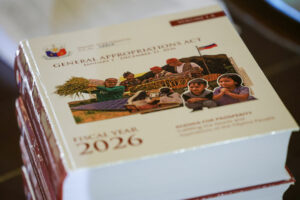
The petition for certiorari and prohibition was filed by Caloocan Rep. Edgar R. Erice and Party-list Rep. Leila M. de Lima, seeking to nullify the unprogrammed funds under the 2026 General Appropriations Act (GAA), which President Ferdinand R. Marcos, Jr. signed into law on Jan. 5.
“There is already a ripe and actual justiciable controversy because the budget has been approved and signed into law. It can always be implemented anytime by the Executive,” Ms. de Lima told reporters in mixed English and Filipino.
“That’s why we filed a petition for certiorari and prohibition. Certiorari because there’s a grave abuse of discretion and prohibition to stop the Executive, particularly the Executive secretary and the Budget secretary, from implementing the unprogrammed funds.”
The lawmakers asked the SC to issue a temporary restraining order to stop the implementation of the questioned appropriations, which they claimed to be unconstitutional.
Unprogrammed appropriations were “standby” funds that may only be released if specific fiscal conditions are met.
The Department of Budget and Management (DBM) has said these funds are intended to support priority programs and projects that cannot yet be fully programmed due to uncertainties in revenue inflows.
These typically include budgetary support for social protection programs, infrastructure projects, debt management, and other government obligations that may require supplemental funding should additional resources become available during the fiscal year.
However, the petitioners argued that the continued inclusion of such funds gives the Executive excessive flexibility in spending, undermining Congress’ constitutional “power of the purse.”
During the filing, Ms. De Lima said the structure of unprogrammed appropriations weakens legislative oversight because Congress is asked to authorize spending without full details on the projects and financing sources.
“Instead of clearly laying out the budget expenditures and the sources of financing, the process is reversed,” Ms. De Lima said. “There is a general program, but there are no specific projects and no definite sources of financing yet.”
“Congress is supposed to authorize spending, but how can it do so if it does not see the specific items under the unprogrammed appropriations? This undermines the entire budget process,” Ms. De Lima said.
She added that if certain expenditures are truly necessary, they should already be included in the programmed appropriations.
“Unprogrammed appropriations are inherently questionable. If these projects are really needed, they should be placed under the programmed appropriations where the projects are clearly identified,” she said. “If excess revenues later materialize, there should be a special appropriations measure so Congress can scrutinize them again, instead of leaving them to executive discretion.”
Mr. Erice, for his part, warned that the financing sources for unprogrammed funds pose significant fiscal risks.
“The most dangerous part is the source of financing. Once these are placed under unprogrammed funds, the government can find ways to source funding — from where?”
He said that the funds could be sourced from asset sales, excessive borrowing that the government may no longer be able to repay, or the imposition of additional taxes.
“These do not pass through Congress because they are already programmed. That is completely wrong,” Mr. Erice added.
In a statement, the DBM maintained that the unprogrammed appropriations under the 2026 GAA are constitutional and consistent with existing jurisprudence.
The agency said the Supreme Court has repeatedly upheld unprogrammed funds as valid “standby appropriations” that are not automatically available for use and may only be released upon the occurrence of clearly defined fiscal conditions, subject to strict validation and control mechanisms.
“It is not a lump-sum fund nor a blank check for spending,” the DBM said.
The DBM also noted that the P150.9-billion unprogrammed appropriations for 2026 represent the lowest level since 2019, reflecting what it described as stronger fiscal discipline and tighter safeguards in budget execution.
“The DBM remains committed to upholding the Constitution, respecting the authority of the courts, and ensuring that the national budget is implemented in a prudent, transparent, and accountable manner,” it said.
The agency added that upon receipt of the petition, it would transmit the case to the Office of the Solicitor General, the government’s statutory counsel.