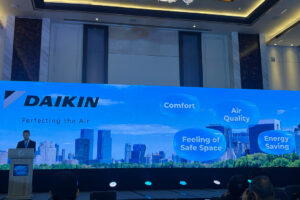
Daikin Airconditioning Philippines Inc. said it aims 15% to 20% sales growth by 2027, after citing challenges last year linked to the Philippine Offshore Gaming Operators (POGOs) ban.
“We had a hard time because technically, this is the result of the POGO exit. When the offices were gone, bids from the developers also went down,” Wesley Andre S. Chu, deputy division manager at Daikin Philippines, told BusinessWorld at the sidelines of an event last Friday.
“This 2026 onwards, we can see that the economy is already recovering, and there will be a lot of townships… We’re looking at approximately an increase from our sales from maybe 15% to 20% by 2027 to 2028 onwards,” he added.
Under Executive Order (EO) 74, POGOs were ordered to cease their operations in the country on December 31, 2024. Data from Colliers Philippines indicate that the vacancy rate in Metro Manila has remained at 19.8% for two consecutive years since the ban.
In 2026, the projected vacancy rate would slightly decline to 19.5%, as the “worst impact” of the POGO exit has likely passed, according to the consultancy firm.
It added that the demand for condominiums, particularly in central business districts, is expected to pick up and likely continue through 2027.
Daikin Philippines echoed the same concern, highlighting fewer office vacancies. “If you will notice, some of the government offices are occupying the buildings left by POGOS,” Mr. Chu said.
Along with offices, the company expects the majority of its sales to come from high-end residential properties.
“Right now, we are targeting high-end residential because our mid to mid-high is still oversupply,” Mr. Chu said. “The projects that the developers are doing now are all high-end because a lot of investors who are coming in need high-end residential.”
The rise of high-end residential units also opens opportunities for retail businesses in townships, including banks, restaurants, and convenience stores.
“Once these projects are completed by 2028 to 2029, retail businesses will enter, so the economy of construction development will continue,” he said.
Data from Colliers in 2024 showed that the upscale to ultra-luxury market segments, costing P12 million and above, accounted for 41% of total condominium launches in Metro Manila. — Almira Louise S. Martinez