By Isa Jane D. Acabal, Researcher
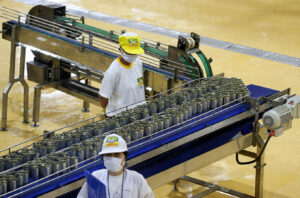
Factory output expanded to a four-month high in December driven by faster increases in the production of other non-metallic mineral products, food products, and a recovery in machinery and equipment, the Philippine Statistics Authority (PSA) reported on Friday.
Preliminary results of the PSA’s Monthly Integrated Survey of Selected Industries showed manufacturing output, as measured by the volume of production index (VoPI), inched up by 1% year on year in December, faster than the 0.5% gain in December 2024.
However, this was a turnaround from the revised 1.1% drop in November.
The latest manufacturing output growth was the fastest pace in four months or since the 1.3% expansion in August 2025.
For 2025, factory output fell by 0.02%, a reversal from the 0.7% annual average growth seen in 2024.
On a monthly basis, December’s output picked up by 0.7% from the 2.3% decline in November. Stripping out seasonality factors, it grew by 4.2%.
In comparison, the S&P Global Philippines Manufacturing Purchasing Managers’ Index (PMI) expanded to 50.2 in December from 47.4 in November.
The PSA said December’s year-on-year growth was driven by faster annual increases in the manufacture of non-metallic mineral products (31.4% in December from 6% in November), food products (10.4% from 7.6%), and a recovery in machinery and equipment except electrical (10.1% from -10.7%).
Twelve other industry divisions posted expansions, while seven saw declines.
According to the PSA, the top three industry divisions that contributed to the overall year-on-year growth of VoPI for manufacturing were food products, other non-metallic mineral products, and computer, electronic and optical products (10.3% in December from 14.5% in November).
“[The] growth fueled by stronger production in food products, non-metallic minerals, and a rebound in machinery and equipment shows how both consumer demand and business investments are helping sustain momentum,” Ferdinand A. Ferrer, president of the Philippine Chamber of Commerce and Industry (PCCI), said in a Viber message.
Marco Antonio C. Agonia, an economist at the University of Asia and the Pacific, said the recovery in VoPI for manufacturing in December can be attributed to “seasonal effects.”
“Manufacturers likely increased production of food products for the holidays, and intermediate construction inputs and machinery as businesses planned for ramped up capex (capital expenditures) in 2026,” he said.
He added that strong export demand may have also encouraged more manufacturing activities.
In December, exports climbed by 23.3% year on year to $6.99 billion from 21.6% growth in November. This was a turnaround from the 1.9% drop in December 2024.
This was the fastest pace for exports in six months, since the 26.9% growth in June 2025.
“The quicker, though still benign, inflation reading may have at least signaled soft inflation into this year, allowing firms to plan ahead accordingly,” Mr. Agonia said.
Inflation quickened to 1.8% in December, picking up from 1.5% in November but easing from 2.9% in December 2024.
This brought the full-year average to 1.7% in 2025 from 3.2% in 2024.
This was the slowest rate in nine years or since the 1.3% rate in 2016 but was slightly above the central bank’s 1.6% estimate for 2025.
The Bangko Sentral ng Pilipinas cut borrowing costs by another 25 basis points in December, bringing key policy rate to 4.5%.
According to Mr. Agonia, the rate cut “likely had little to no impact” in December’s manufacturing output because they usually take at most two years to “fully work their way through the financial system.”
For Union Bank of the Philippines Chief Economist Ruben Carlo O. Asuncion, the central bank’s accommodative monetary policy helped eased financing conditions amid the benign inflation.
“Lower borrowing costs gave firms more room to manage operating expenses, supporting production decisions and stabilizing manufacturing activity,” he said.
Mr. Asuncion expects moderate growth in manufacturing output this year as “supported by a more accommodative policy stance and resilient consumer demand.”
PCCI Honorary Chairman Sergio R. Ortiz-Luis, Jr. also sees improvement in the manufacturing output this year.
“The projection [on factory output] towards this year, early part of this year, will still be going up. Not in a big way, but it will be positive,” he said in a phone call.
Mr. Agonia expects “mild improvements” in the manufacturing performance this year as business sentiment recovers from the economic slowdown in the fourth quarter and full-year 2025.
“However, any significant changes from the status quo may require more concerted efforts towards improving manufacturing sector conditions,” he said.
Gross domestic product (GDP) expanded by 3% in the fourth quarter of 2025, a slowdown from the 5.3% in the same period in 2024 and the revised 3.9% print in the third quarter of 2025.
This brought the full-year economic growth to 4.4%, missing the government’s 5.5% to 6.5% target.
The latest annual GDP print was slower compared to the 5.7% growth in 2024 and was the weakest growth since the 9.5% slump in 2020.
December’s capacity utilization, or the extent to which industry resources are used in producing goods, averaged 77.5 % in December, higher than the revised 77.4 % in November and the 76.1% posted in the same month in 2024.
Looking ahead of 2026, Mr. Ferrer said the PCCI remains “cautiously optimistic.”
“Continued government infrastructure projects, strong local consumption, and supportive monetary policy should help sustain growth. At the same time, challenges like rising global prices, supply chain issues, and energy costs must be addressed,” he added.