By Aubrey Rose A. Inosante, Reporter
THE DEPARTMENT of Budget and Management (DBM) expects government agencies to submit lower funding proposals for 2027 amid stricter vetting guidelines triggered by the flood control corruption scandal.
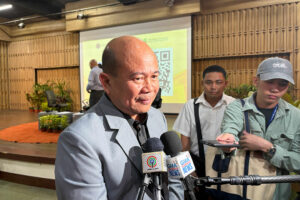
Acting Budget Secretary Rolando U. Toledo said requests may come in below the P11-trillion plan last year, after the agency issued stricter guidelines in its 2027 budget call in preparation for the National Expenditure Program (NEP).
“Yes, we expect (lower proposals), but we cannot prevent them from submitting more than what is supposed to be,” he told BusinessWorld on the sidelines of a University of the Philippines School of Economics event on Feb. 6.
“But of course, given the guidance we’re providing them, we hope the proposals will be lower,” he added.
The DBM began preparing the fiscal year 2027 budget through a series of budget forums with government agencies and government-owned and -controlled corporations late last month.
“We amplified the call to safeguard our budget from corruption,” Mr. Toledo said.
Safeguards include requiring agencies to secure approval from Regional Development Councils for priority programs and projects, reinforcing coordination among national agencies, regional offices, and local governments to prevent spending that is misaligned with administration priorities.
Additionally, the DBM mandates that proposals are backed by data, past performance metrics, and detailed program plans with clear procurement and implementation timelines and milestones.
“This ensures that only implementation-ready, high-impact proposals receive funding, reinforcing both equity and the effective allocation of public resources,” he said.
Mr. Toledo also pledged stricter oversight and reforms, saying agency heads will be required to certify accounts payables using signed, notarized documents to ensure projects are legitimate and not “ghost” transactions.
He also said the agency’s Technical Innovations for the NEP Application will automate the Executive’s budget tracking and formatting, significantly reducing the time and risk of discrepancies in report generation and review, which is expected to be rolled out in fiscal year 2028.
RISK OF UNDERFUNDINGAnalysts said a sharp cut in 2027 budget proposals signal more disciplined spending but risk underfunding of key programs and misalignment with economic priorities.
Jonathan L. Ravelas, a senior adviser at Reyes Tacandong & Co., said the stricter guidelines will likely force agencies to scale back their 2027 proposals, as the DBM continues to stress that fiscal space remains tight.
“Lower proposals could help ease fiscal pressure, but the challenge now is to cut the fat without starving essential programs — so agencies need to be smarter, not just smaller, in what they submit,” he told BusinessWorld in a Viber message.
Mr. Ravelas noted that corruption tied to anomalous flood control projects pushed the government toward a more disciplined, longer-term approach to budget preparation, with tougher validation.
However, Leonardo A. Lanzona, an economics professor at the Ateneo de Manila University, said that as the DBM tightens access to the budget, agencies may respond with fewer or smaller proposals, a move that doesn’t necessarily align spending with economic priorities or growth programs.
“You could end up with agencies abandoning worthwhile projects that support government economic goals simply because the access process is too burdensome, while the fundamental question of strategic resource allocation remains unaddressed,” he said in a Messenger chat over the weekend.
Mr. Lanzona said the lack of fiscal discipline amounts to “an austerity program without a clear goal,” warning it could cause delay rather than delivering meaningful budget reform.
John Paolo R. Rivera, a senior research fellow at the Philippine Institute for Development Studies, said agencies may become overly cautious in budgeting, which may leave key infrastructure and social programs with less funding.
“While the corruption scandal may prompt more transparency and tighter justification of budgets, the shift will only be structural if reforms are institutionalized rather than treated as a short-term compliance response,” he said.
UNPROGRAMMED APPROPRIATIONSAt the same event, Mr. Toledo rejected anew calls to remove unprogrammed appropriations (UA) from the national spending plan.
“The unprogrammed appropriation is not really a bad proposal, having that in the budget. What is wrong is how do we use unprogrammed appropriations,” he told reporters.
According to the DBM, the UA refers to funds that can be used only for specific projects when revenue collection exceeds targets or when additional grants or foreign funds are secured.
Mr. Toledo added that he will not recommend scrapping the UA, as many key projects are still awaiting approval. Without the UA, projects may delay implementation, he said.
“Just like for 2026, we have limited only to three particular lists of unprogrammed appropriations. One is for the foreign assistance project, the risk management program, plus the AFP (Armed Forces of the Philippines) modernization program,” he said.
Mr. Toledo also said he wants to continue limiting the standby funds to below 5% of the budget.