By Vonn Andrei E. Villamiel
WHEN A WALL of garbage gave way at Cebu City’s Binaliw landfill this month, killing dozens of workers, it revived memories of a disaster the Philippines had pledged never to repeat.
At dawn on July 10, 2000, a towering mound of waste collapsed at the Payatas dumpsite in Quezon City after days of heavy rain. Homes were buried, fires broke out, and more than 200 people were killed.
The tragedy prompted a national reckoning and led to the passage exactly 25 years ago of the Ecological Solid Waste Management Act, which banned open dumps and ordered local governments to shift to safer disposal systems.

But the Binaliw collapse suggests that the country’s waste system remains vulnerable to the same failures of design, oversight and enforcement that caused the Payatas tragedy.
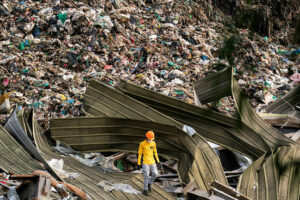
On Jan. 8, a massive garbage pile — estimated by local officials to be as tall as a 20-storey building — gave way at the landfill in the village of Binaliw, crushing a material recovery facility and trapping workers beneath tons of debris.
After 10 days of search operations, the Cebu City government confirmed 37 deaths, including one rescuer who later died from septic shock.
City officials cited prolonged rainfall, water-logged waste, and structural weaknesses as factors behind the collapse. Environmental advocates and local lawmakers say those explanations point to a deeper issue: a landfill system that exists largely on paper.
Binaliw is operated by Prime Waste Solutions, Inc., a unit of Prime Infra Capital, Inc. It is listed by the National Solid Waste Management Commission (NSWMC) as a controlled sanitary landfill, one of 375 operating across the country. It serves Cebu City as well as the neighboring cities of Mandaue and Lapu-Lapu, receiving about 573 metric tons of waste daily.
‘LIKE A 20-STOREY BUILDING’Cebu City Councilor Joel C. Garganera, who heads the council’s environment committee, said the facility functioned more like an open dumpsite.
“It is not the usual landfill where you dig the ground, put liners and stop once the waste reaches the surface or slightly above it,” Mr. Garganera told BusinessWorld. “What happened in Binaliw is that the garbage piled up like a 20-storey building.”
The garbage was stacked upward, relying on a hillside for support. The site was cut into a slope, with waste piled against it rather than embedded below ground, he said. That design, combined with poor drainage, made the landfill prone to saturation and collapse.
“This is an open dumpsite, and it’s like a sponge that absorbs water,” he said. “Even mountains made of rock experience landslides. What more a mountain made of garbage.”
Regulators had flagged issues at the site years before the collapse. In 2019, the Environmental Management Bureau (EMB) in Central Visayas issued violation notices to the landfill’s former operator for improper handling and missing monitoring reports. Prime Waste Solutions took over operations in 2023 and pledged upgrades, including an automated recovery facility.
Complaints persisted. Residents in nearby Consolacion raised concerns about water quality, suspecting groundwater contamination from leachate.
In August last year, Cebu City’s Solid Waste Management Board said the landfill violated the waste law by allowing untreated disposal, according to local media reports. No penalties were imposed at the time.
Operations were halted only after the Jan. 8 collapse, when the EMB issued a cease-and-desist order after an inspection.
Prime Waste Solutions did not respond to requests for comment.
OVERSIGHT GAPSFor environmental groups, Binaliw underscores how weak monitoring has undercut a law designed to prevent such disasters.
“The policy is there, including how landfills should be operated,” Ochie L. Tolentino, zero-waste campaigner at EcoWaste Coalition, told BusinessWorld by telephone in mixed English and Filipino. “However, the DENR (Department of Environment and Natural Resources) is lacking in terms of monitoring these waste facilities.”
Under the Solid Waste Management Act, landfill operators must submit regular reports to regulators, while the DENR is tasked with oversight. Ms. Tolentino said paperwork alone couldn’t capture on-the-ground risks.
“How can regulators verify these reports if there are no actual site inspections?” she asked.
Similar incidents have occurred since Payatas. In 2011, trash slides at dumpsites in Baguio City and Olongapo killed at least eight people after heavy rains. Yet open dumps have continued to operate.
As of 2021, the EMB reported that about 230 open dumpsites remained active nationwide, even as authorities said hundreds had been closed.
In a statement on Monday, the Environment department said it has formed an investigative body, including third-party representatives, to probe the Binaliw incident.
The agency also ordered a nationwide inspection of all operating sanitary landfills and directed its regional offices to enforce environmental compliance certificates and safety protocols.
“We are moving to ensure that facilities across the country adhere to the highest standards of safety and environmental protection,” Environment Secretary Raphael P.M. Lotilla said.
The pressure on landfills is growing. The Philippines generated about 60,700 metric tons of waste a day in 2025, according to NSWMC data. That figure is projected to exceed 63,500 tons a day by 2030 as cities expand and consumption rises.
Much of that waste still ends up buried. Less than 10% of plastic waste is recycled, while about a fifth leaks into waterways and the ocean, based on World Bank and DENR figures.
Marian Frances T. Ledesma, zero-waste campaigner for Greenpeace Philippines, said the system remains focused on disposal rather than prevention.
“The Philippines is experiencing a waste crisis with volumes of waste increasing and impacts worsening,” she said in an e-mailed reply to questions. “Our waste management system fails to address the problem at its source.”
The law requires local governments to reduce waste through segregation, recycling and composting. Organic material makes up about half of the country’s waste stream, yet diversion remains limited.
Poor segregation worsens landfill instability, Ms. Ledesma said. Organic waste increases moisture, while plastics reduce density, raising the risk of slides when heavy rains hit.
PLANS WITHOUT PRACTICELocal governments must submit 10-year waste management plans. Data on the NSWMC website show about 60% of municipalities had approved plans, though council members say more recent figures put the rate above 80%.
“Having a waste management plan is one thing, but implementation is another,” Ms. Tolentino said. “Waste diversion should be closely monitored in the local government level to reduce the amount of trash going to landfills.”
Without reductions at source, landfills absorb the strain. In places like Binaliw, that strain became fatal.
For survivors of Payatas, the parallels are stark.
Leonora Dolores, who lived near the Quezon City dumpsite when it collapsed, said the sound of garbage giving way is something she would never forget. Two decades later, she said the lesson had not been learned.
“If the risks are already known, action should come before people die,” she said.
The Binaliw tragedy has reopened questions the country has faced since 2000: whether waste rules are enforced, whether landfills are built as designed and whether oversight keeps pace with growing volumes.
Until those gaps are addressed, environmental groups say, disasters like Payatas and Binaliw will remain a recurring risk rather than a closed chapter.