By Brontë H. Lacsamana, Reporter
WHILE ILONGGOS are not the loudest cheerleaders when it comes to their cuisine (unlike, say, folks from Pampanga), once you get them started about what food to eat or places to go to, you quickly realize there’s endless love and plentiful recommendations to tick off from your checklist. It’s a culinary gem in the Western Visayas region, which most Filipinos don’t know was actually a rich source of food in our history.
Because it continues to preserve and support its culinary heritage, composed of indigenous recipes and emboldened by various native ingredients, Iloilo City was the first in the Philippines to be recognized by UNESCO (United Nations Educational, Scientific and Cultural Organization) as a Creative City of Gastronomy.
In January, a press trip around Iloilo was organized by its MICE (Meetings, Incentives, Conferences and Exhibitions) Center, coinciding with the Dinagyang Festival.
“Iloilo is where the past meets the present. That’s what the UNESCO designation celebrates. It celebrates our culinary traditions, our heritage. It’s part of our history,” said Leny Ledesma, Iloilo City executive assistant for special projects, during the media tour.
Unlike the Michelin star, which celebrates a particular chef or kitchen, the Creative City of Gastronomy title celebrates culinary heritage.
SEAFOOD, CHICKEN, PANCIT MOLO
The first stop was Tatoy’s Manokan and Seafoods, known for its inasal chicken and seafood dishes, ranging from sinigang na tanigue (mackerel fish soup) to grilled squid to baked oysters.
For Manileños, diwal (angel clams) would be a novelty, with its elongated shape reminiscent of angel wings. Tatoy’s paella Valenciana is also delicious, while their kilawin offers a refreshing punch to the spread — everything proof of how Iloilo does justice to its abundance of seafood.
Kap Ising’s Pancit Molo is the next must-visit for Ilonggos returning home and visitors to the region.
Eliezer Villanueva, better known as Kap Ising, served us himself. Originally located in the Molo district, the branch we visited was in Ayala Malls Atria, one of eight branches now, though all offer the same menu. We were given bowls of their mouth-watering pancit molo (wonton soup), dinuguan at puto (pork blood stew and rice cake), and empanadas (stuffed pastry).
Mr. Villanueva’s iteration of the restaurant came about in 2006, when he took over from his mother’s restaurant, Nida’s Original Pancit Molo, which dates to the 1980s. The dish itself comes from the Chinese community in Iloilo, largely based in the Molo district, which was absorbed into Ilonggo cuisine.
His mother used to cook, while he sold the dish at city hall and at banks.
“I’ve been a barangaycaptain for 30 years, kaya tawag sa’kin Kap Ising (so they call me Kap Ising),” he said.
When asked about the integrity of the recipes over time, he pointed out the use of ingredients as a major factor. The dumplings in the pancit molo are filled with ground pork, shrimp, and chicken — none of which are frozen, he specified, because the taste would be different — while the empanadas make use of potatoes and ground tenderloin.
“Hindi ako bumibili ng imported. Kailangan bagong katay (I don’t buy imported [ingredients]. It has to be freshly butchered).”
Though our group easily finished our bowls, Kap Ising encouraged refills, which we noticed was normal for diners at other tables, too. The homey feel was there all throughout the meal.
COFFEE AND ICE CREAMThe next stop was Madge Café — again, a branch at Atria — which somehow manages to capture the charm of the original location. First set up as a stall in La Paz Market in 1940, its coffee is still prepared in the old way, manually strained using kettles and collador (cloth socks) as a filter. Mugs engraved with names of regular customers adorn the walls, an homage to how the original market stall was supported by locals.
It was established by Vicente de la Cruz, who named the café after his wife, Magdalena. Now, various second- and third-generation family members operate the different branches. A few days after having a warm and comforting cup of joe at the Atria branch, we trooped over to the original La Paz Public Market outlet for more, this one run by grandson Peter “Nonoy” de la Cruz.
“Madge is a legacy passed down in our family,” he told BusinessWorld. “The coffee really comes from Iloilo. It’s homegrown. We do the roasting with no preservatives added. Many people don’t know this, but we’re really producers of coffee.”
Another showcase of Iloilo’s homegrown ingredients is the Happy Endings Creamery and Food Lab, which is best known for its iconic spot in front of Molo Mansion. There, we fell in love with its local flavors — batwan (green sour fruit) cheesecake and baye-baye (roasted glutinous rice and coconut).
Served alongside the usual ice cream flavors like chocolate, salted caramel, and pistachio, the Iloilo ingredients highlighted give a sweet, unique spin on the flavors found in the region.
FROM PLAZAS TO THE SEASIDEA memorable stop was Agatona 1927 Museum Café, which is housed in the Jalandoni-Montinola ancestral home overlooking Jaro Plaza. Its heirloom recipes are sumptuous, harkening to the originals yet more refined: pinitaw na manok (chicken adobo flakes), their take on dinuguan, and even biscocho (toasted bread) for snacks.
Their tsokolate-eh (hot chocolate), served with ibos (the Ilonggo version of suman or rice cake), is also a favorite, best enjoyed looking out the window at the landmarks of central Jaro, from the plaza to the cathedral.
Ms. Ledesma, representing Iloilo’s MICE Center, told BusinessWorld that the proposal they submitted to UNESCO for the City of Gastronomy designation awarded in 2023, was one “based on abundance.”
“We’re surrounded by rivers, seas, farms, and mountains in the provinces, so there’s ample food,” she explained. “It’s historical. Miguel Lopez de Legazpi, when he was in Cebu, needed to feed his crew. He searched and landed on this island, in Panay. When he landed, the first thing he said was, ‘pan ay!,’ in Spanish, ‘ay pan!’ which literally means ‘there’s bread!’ There’s food. He had found rice and vegetables.”
The exact place he landed at was Oton, 11 kilometers west of Iloilo City. Next to it is Arevalo, the city’s westernmost district, which is home to many seaside restaurants that Ilonggos frequent for fresh seafood meals with family.
We visited one such restaurant, Breakthrough, overlooking a tranquil beach and the sea that reaches out towards Guimaras (which is famed for its mangoes). It’s no wonder that the ripe mango and green mango shakes here were divine.
Not to be missed, however, is the food itself, ranging from local lechon manok to shellfish such as crayfish and scallops, as well as the iconic diwal. The grilled fish items on the menu are best paired with vegetable dishes like chopsuey.
“The abundance was clear during the pandemic. We weren’t scared because we had backyard farms. Out of 180 barangays [in Iloilo City], 80 barangays had farms to feed their constituents there, boasting the lowest or even zero malnutrition of children,” said Ms. Ledesma. “Our story isn’t just about establishments. It starts from produce, from farmers and markets.”
The UNESCO designation also helped foster pride among Ilonggos, encouraging them to share their heirloom recipes with more people. “Unless you know the specific families and get to eat in their houses, you wouldn’t get to taste all this food. Now, people are sharing it and spreading it. If we lose these traditional recipes, we lose our cultural identity,” she said.
SIOPAO, BATCHOY, FUSIONAnd in the middle of watching the Dinagyang festivities, Roberto’s Queen Siopao kept us full and energized. It’s an Ilonggo favorite, the siopao made of Chinese sausage, adobo flakes, and bits of boiled egg.
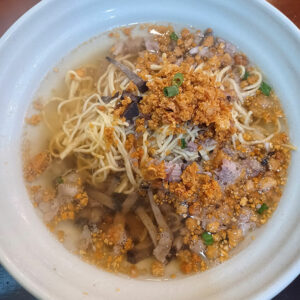
One of our final stops was Netong’s in La Paz, where we tried their batchoy (a noodle soup with pork offal, pork cracklings, and a variety of other parts of pork). It’s way better than the instant noodle counterpart, which was the basis of comparison for most of the media in the tour group. The savory goodness of the broth, only possible by mixing the ingredients of batchoy and eating it immediately while still hot, is to die for.
An unexpected discovery, which we found on our last night in the city, was Forum Rooftop Dining and Lounge, located in The Grid Building in the Mandurriao district. Newly opened, it offers elevated fusion cuisine including salads, pastas, and luxuriously prepared comfort food like lechon, pork knuckles, and pulled duck. It also has cocktails perfect for a classy night out observing the Iloilo skyline.
Amid the sleek yet comfortable interiors of dark stone walls, marble-topped tables, and chinaware custom-made by Lanelle Abueva, BusinessWorld spoke with Forum chef Miner Del Mundo.
“I’ve been in Iloilo for 20 years. I fell in love with the place, and it has become my second home,” he said. Hailing from Silang, Cavite, his history as a chef spans work abroad as well as for world-class hotels. Ms. Ledesma playfully calls him “ilonggated.”
When asked to describe what made Iloilo his second home, he joked, “Wala kasi traffic dito (There is no traffic here),” then added, “Restaurants here used to serve softdrinks in bottles with colorful straws. There were only two Italian restaurants back then. The dining scene has improved since, but I was challenged.”
In addition to Forum, Mr. Del Mundo also runs popular restaurants in the city like Azul and Amarillo. In a nutshell, he described Iloilo as “very pure, with a lot of raw materials and ingredients.”
Over the course of a few days, whether it’s Dinagyang season or not, any visitor would find that to be true — UNESCO designation or not.